A Facility Manager’s Guide
If you manage a residential society, a college campus, a hospital, an airport, or a railway station, you already know a truth that
smaller facilities never have to deal with: the space is simply too big for people alone to keep clean.
It doesn’t matter whether you’re responsible for a gated township with sprawling internal roads, a hospital with corridors that
never stop seeing footfall, or a railway platform that thousands of people pass through every hour — the underlying challenge is
identical. You have a large area, constant use, and a cleaning budget that isn’t growing as fast as your maintenance
responsibilities.
This is exactly the problem mechanized cleaning equipment — ride-on sweepers and scrubber dryers — was built to solve. Here’s
how facility managers across these very different sectors are approaching it.
The Shared Challenge Behind Very Different Facilities
At first glance, a residential township and an airport terminal don’t have much in common. But strip away the specifics, and
facility managers across these sectors are all wrestling with the same three pressures:
Scale that keeps growing. Townships add new phases. Colleges add new blocks and hostels. Hospitals expand wings. Airports
add terminals. Every expansion adds more area to clean, but headcount budgets rarely expand at the same pace.
Cleaning that can’t stop for cleaning. Hospitals run 24/7. Airports and railway stations never close. Even residential societies
and college campuses have common areas in near-constant use. There’s no convenient window to shut things down for a deep
clean.
Rising expectations, fixed budgets. Residents, patients, students, and passengers all expect visibly clean, well-maintained spaces
— and complaints escalate fast when that expectation isn’t met. Meanwhile, most facility budgets are under the same pressure to
do more with the same money, or less.
Manual cleaning teams, on their own, struggle against all three of these pressures simultaneously. This is where the right
equipment changes the math entirely.
What Each Sector Actually Needs
While the core challenge is shared, the specific cleaning demands vary meaningfully by facility type — and understanding this
helps you choose the right equipment instead of a generic solution.
Residential Societies and Townships
Internal roads, parking areas, clubhouse zones, and common walkways need daily sweeping, often across a layout with speed
bumps, parked vehicles, and pedestrian movement. The priority here is a machine that’s maneuverable enough for tighter internal
roads but still covers enough ground that one operator can handle the full property in a reasonable shift.
Colleges and Educational Campuses
Large open plazas, walkways between blocks, parking areas, and hostel zones all need regular cleaning, typically on a schedule
that works around student movement patterns. Noise matters here too — cleaning often has to happen without disrupting classes
or study areas nearby.
Hospitals
Hospital cleaning has an added layer most other facilities don’t: hygiene compliance isn’t optional, it’s regulatory. Corridors,
lobbies, and large paved areas around the facility need to be kept spotless continuously, and floor cleaning inside the building (via
scrubber dryers) needs to meet hygiene standards without disrupting patient movement or emergency access routes.
Airports and Railway Stations
These are the highest-footfall, highest-visibility environments on this list. Cleaning has to happen constantly, around the clock,
without ever visibly disrupting passenger flow. Dust control, noise levels, and maneuverability around crowds, luggage, and
seating areas are all critical considerations.
Two Categories of Equipment, Two Different Jobs
Most large campuses actually need a combination of two equipment types, each solving a different part of the cleaning challenge:
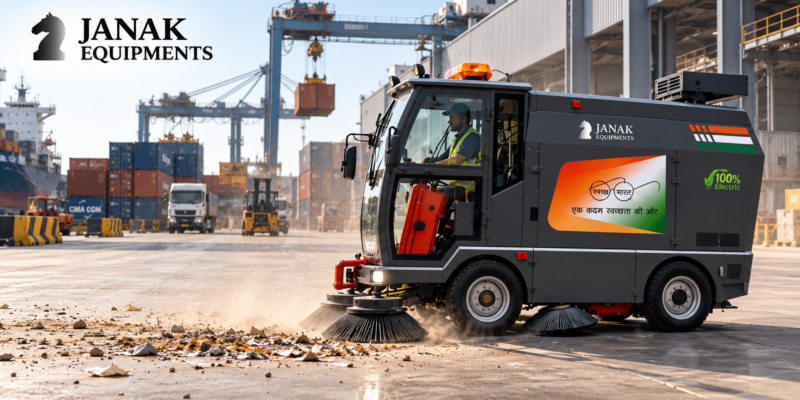
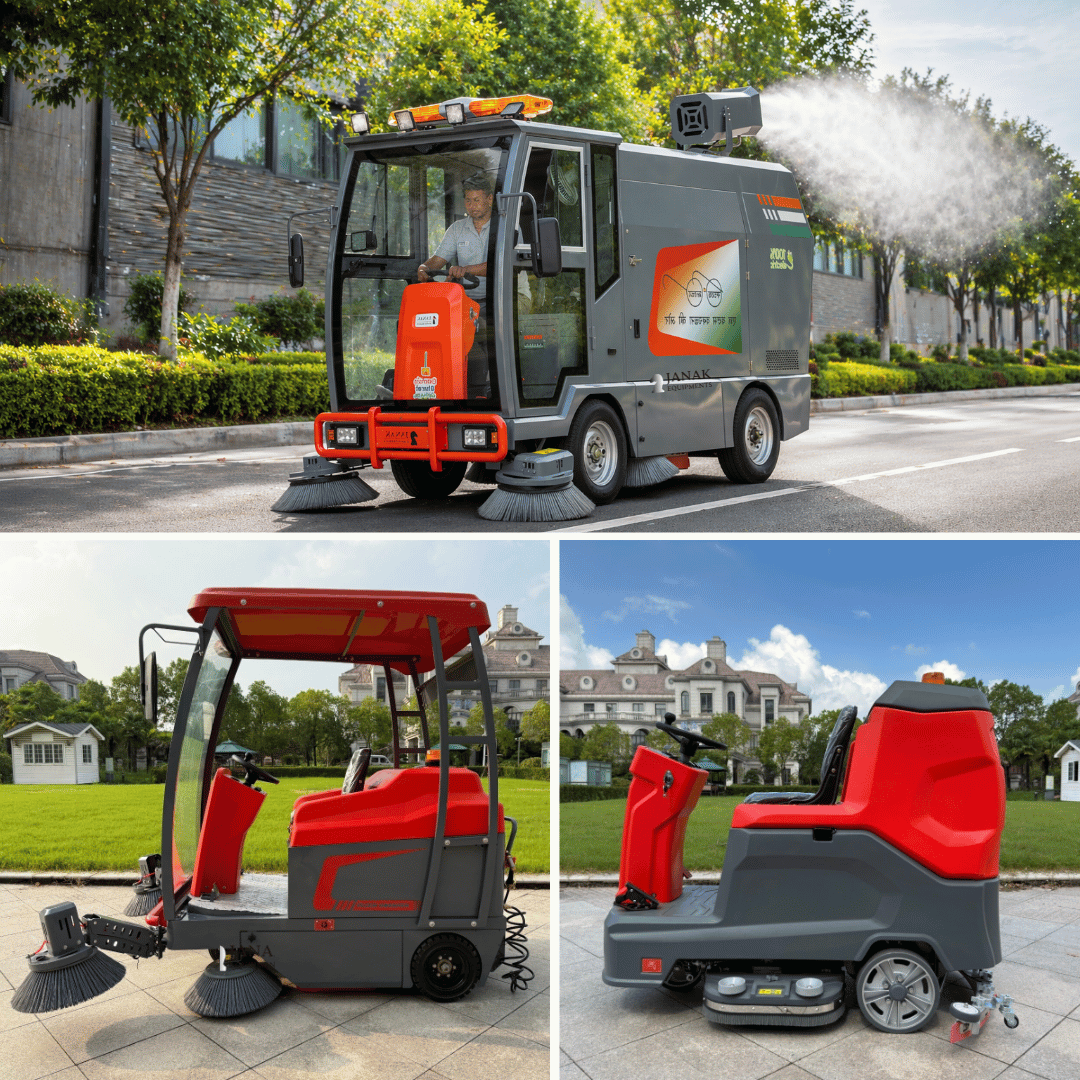
Ride-on sweepers handle outdoor and semi-outdoor areas — roads, parking lots, open plazas, pathways, and approach areas.
They’re built for sweeping up dust, leaves, debris, and general litter across large paved surfaces.
Scrubber dryers handle indoor hard floors — lobbies, corridors, waiting areas, and indoor common spaces. They wash, scrub,
and dry floors in a single pass, which matters enormously in high-footfall indoor areas where a wet floor left to air-dry is both a
safety hazard and an operational bottleneck.
Understanding which of your problem areas is outdoor/semi-outdoor versus indoor hard-floor is usually the first step in figuring
out what equipment mix your facility actually needs.
Why This Approach Actually Saves Money
It’s easy to see mechanized equipment as an added cost rather than a saving — until you look at what it actually replaces.
One operator covers what multiple manual workers would take hours to do. For large properties, this is the single biggest
driver of cost efficiency. Instead of scaling your cleaning staff every time your property adds a new block or phase, one machine
and one trained operator can absorb a significant amount of that additional area.
Consistent quality reduces complaint-driven costs. In residential societies, this means fewer resident complaints and RWA
escalations. In hospitals, it means fewer compliance issues. In colleges, fewer maintenance department callouts. Consistent,
scheduled mechanized cleaning tends to prevent the “emergency cleanup” costs that come from inconsistent manual coverage.
Lower long-term operating costs with electric equipment. Facilities increasingly prefer electric, lithium-ion powered machines
over diesel or older battery technology, since maintenance and running costs tend to be lower over the equipment’s life — a
meaningful factor for any facility budgeting cleaning costs over a multi-year horizon.
Staff can be redeployed, not just reduced. Mechanization doesn’t have to mean cutting your cleaning team. Many facility
managers use it to redeploy staff toward tasks machines can’t do — detailed indoor cleaning, washroom maintenance, and areas
requiring human judgment — while machines handle the large, repetitive ground coverage.
What to Look for When Choosing Equipment for Your Facility
Regardless of which sector you’re in, a few considerations apply across the board when evaluating ride-on sweepers or scrubber
dryers for a large campus:
● Maneuverability — Can it navigate your tightest corners, parking areas, or corridor widths without difficulty?
● Noise level — Especially critical for hospitals, colleges, and any facility with quiet zones
● Battery-powered operation — No fumes or emissions, important for indoor use and enclosed campus environments
● Build durability — Stainless steel construction that holds up to daily, sometimes multi-shift, continuous use
● Coverage per charge — Matters more as your property size increases; undersized battery capacity means more charging
interruptions during a shift
● Ease of operator training — Facilities with staff turnover benefit from equipment that’s straightforward for new operators
to learn quickly
A Simple Way to Start
If you’re managing a large facility and haven’t yet introduced mechanized cleaning equipment, you don’t need to overhaul your
entire operation at once. A practical starting point:
1.
Identify your highest-traffic, highest-visibility zones — the areas where cleanliness (or the lack of it) generates the most
complaints or compliance concerns.
2.
Separate outdoor/semi-outdoor coverage from indoor hard-floor needs — this tells you whether you need a ride-on
sweeper, a scrubber dryer, or both.
3.
Pilot on one zone or block before rolling out property-wide, so you can measure the actual time and labor savings against
your current manual deployment.
4.
Talk to a supplier who understands your sector — the right machine size and configuration for a residential township is
different from what an airport terminal needs, even though both are “large facilities.”
Built for the Scale These Facilities Demand
At Janak Equipments, we work across all of these sectors — residential societies, educational campuses, hospitals, airports, and
railway stations — because the underlying engineering challenge is the same even when the setting looks different: reliable,
durable machines that can handle continuous, high-footfall use without breaking down or slowing your operation.
Our ride-on sweepers and scrubber dryers are built with 100% stainless steel bodies and advanced lithium-ion battery systems,
designed specifically to hold up under the kind of daily, multi-shift use large campuses and institutions demand.
Managing a large residential, educational, healthcare, or transit facility? Get in touch with our team to find the right ride-on sweeper for your operation, or explore our full range of ride-on sweepers built for Indian conditions.
Janak Equipments designs and delivers next-generation cleaning machines for municipal, industrial, and commercial operations across India. Learn more about us.